AI-Powered Practice Simulation:
Audience
Responsibilities
Tools
Language
Overview
Managers and team leads responsible for introducing AI-supported tools or workflows within their teams.
Claude AI (Sonnet 4.6)
Visual Studio Code / HTML editor
Perplexity
Research & Content Curation
Instructional Design & Scenario Architecture
Character & Psychology Design
Design Brief Development
Prompt Engineering
AI-Assisted Prototyping
Content Review & Refinement
UI & Visual Design Adjustments
English (US)
This project showcases the potential of AI-powered, dynamic, conversation-based learning experiences that transcend static branching scenarios. Learners take on the role of a manager having a one-on-one conversation with an employee who is resistant to the implementation of AI. They must uncover the reasons behind the employee's behavior before deciding how to respond.
I designed and prototyped a dynamic roleplay simulation using Claude AI, in which an AI character responds dynamically to the learner's questions. The simulation was developed based on a structured design brief covering scenario design, character psychology, feedback rubrics, and learning objectives. The final prototype includes a scenario briefing, a live conversation, a structured reflection, and personalized, AI-generated coaching feedback.
This project illustrates how AI can create realistic, adaptive learning experiences, which are challenging to achieve with traditional e-learning methods.
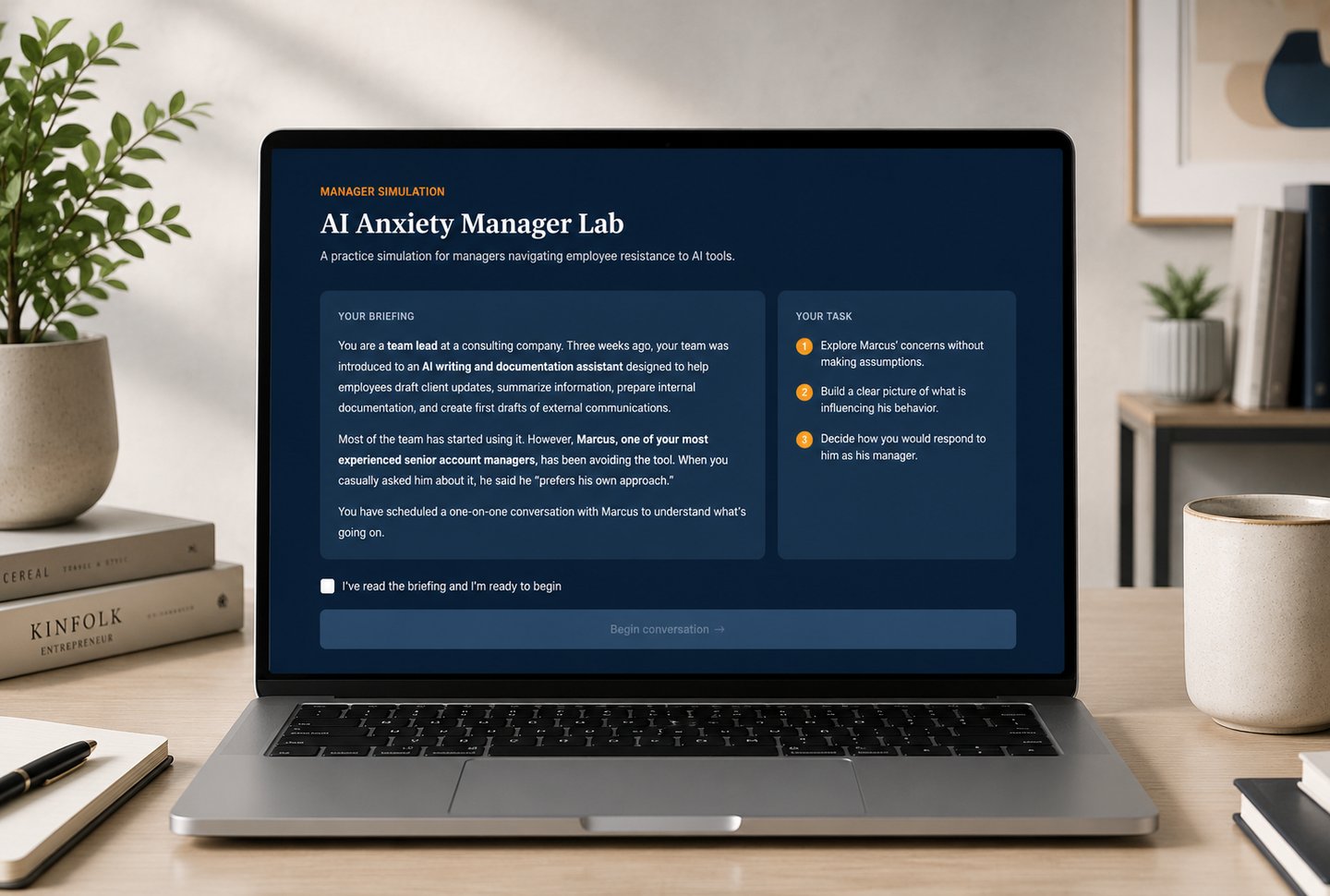
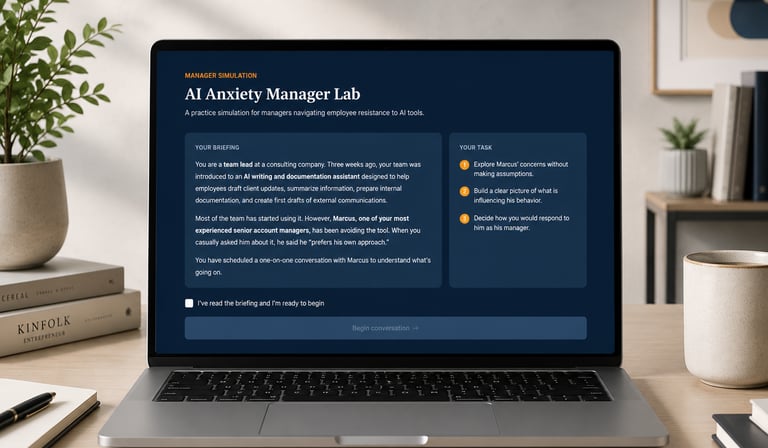
AI Anxiety Manager Lab


Please note: this simulation is powered by Claude AI and may require a free Claude account. Also, the number of interactions may depend on your Claude usage limits.
Design Brief for Simulation Prototype
# Design Brief: AI Anxiety Manager Lab
### Overview
An interactive, AI-powered simulation for managers. The learner practices uncovering and responding to employee resistance toward a newly introduced AI tool. The experience is split into two parts: a diagnostic conversation, followed by a written assessment that receives personalized AI feedback.
---
### Target Audience
Managers and team leads responsible for introducing AI-supported tools or workflows within their teams.
---
### Learning Objectives
By the end of this simulation learners are able to:
- Explore employee resistance to AI through open questions and active listening.
- Recognize deeper concerns that may underlie surface-level objections.
- Create psychological safety for employees to discuss uncertainty and fear related to AI adoption.
- Develop appropriate responses that combine empathy, transparency, and concrete next steps.
---
### Scenario
The learner takes the role of a Team Lead at a consulting company. Three weeks ago, the team was introduced to an AI assistant designed to help draft client updates, summarize information, and prepare internal and external communications. Most of the team has adopted it — but Marcus, one of the most experienced Senior Account Managers, hasn't used it once. When asked casually, he said he "prefers his own approach." The learner has called him in for a one-on-one to understand what's going on.
---
### Character: Marcus
Role: Senior Account Manager, 17+ years at the company
Personality & tone: Polite, professional, reasonable-sounding. Not aggressive or openly hostile. He presents himself as someone raising legitimate concerns, which makes him harder to read.
Resistance structure (three layers):
| Layer | Type | What Marcus says/shows |
| --- | --- | --- |
| Surface | Quality concern | "The tool gets things wrong. I spend more time correcting it than just writing myself." |
| Hidden 1 | Professional identity | His writing and client communication have always been his craft and how he stands out. AI making that "easy" feels like a devaluation of something he's proud of. He won't say this directly — it surfaces through the right questions. |
| Hidden 2 | Job security fear | If AI can do what he does, what is he still needed for? This is the deepest layer and only emerges if the learner creates genuine psychological safety. |
Important: Marcus does not volunteer these layers. He responds to the quality of the learner's questions and empathy. Poor questions keep him at the surface. Good questions unlock Layer 1. Genuinely safe, non-judgmental dialogue unlocks Layer 2.
---
### Experience Structure
Screen 1 — Intro Briefing
Displays the scenario context. Single "Start Conversation" button.
"You are a Team Lead at a Consulting Company. Three weeks ago, your team was introduced to an AI assistant designed to help draft client updates, summarize information, and prepare internal and external communications. Most of your team has started using it, but you've noticed that Marcus, one of your most experienced Senior Account Managers, hasn't touched it once. When you asked casually, he said he 'prefers his own approach.' You've decided to have a proper one-on-one with him today to understand what's going on."
Screen 2 — Conversation with Marcus
- Open-ended chat interface. No turn limit.
- The learner types freely. Marcus responds dynamically and in character.
- A persistent button is visible throughout: "I understand Marcus' reasons — submit my assessment"
- Learner clicks this when they feel ready, regardless of how many exchanges have taken place.
Screen 3 — Reflection & Assessment Form
Three text input boxes:
- Box 1: "What's the one thing you're least certain about from this conversation, and why?"
- Box 2: "Based on your conversation with Marcus, what do you believe are his reasons for resistance? Be as specific as possible."
- Box 3: "What is your recommendation for how to respond to Marcus? What would you do next?"
Single Submit button.
Screen 4 — Personalized AI Feedback
The AI evaluates both written answers against the three learning objectives. Feedback is:
- Direct but encouraging in tone
- Specific about what the learner identified correctly
- Clear about what context or nuance they missed — and why it matters in practice
- Closes with one concrete takeaway
The three outcome levels (used internally to calibrate feedback, not labeled for the learner):
1. Surface only — learner identified quality concerns, gave generic advice → feedback notes the missed depth and what a deeper conversation could have revealed
2. Mid level — learner identified professional identity concerns, showed empathy → feedback affirms this and points toward the job security dimension they may have missed
3. Deep — learner identified both hidden layers, responded with empathy and concrete reassurance → feedback affirms the approach and reinforces the specific best practices applied
---
### Tone & Style
- Clean, minimal UI — professional but not corporate-cold
- No gamification, no scores, no progress bars during the conversation
- Feedback screen feels like a thoughtful coaching note, not an automated quiz result


The final simulation emerged from a structured, iterative design process. Instead of starting with the technology, I first defined the learning problem, audience, and objectives. Then, I progressively refined the scenario, Marcus's layered motivations, the conversation flow, the feedback rubric, and the outcome logic. This approach enabled the AI-powered interaction to support specific learning goals and instructional design principles instead of relying solely on AI-generated interactions.

